Let’s be honest. If you have a small kitchen, opening a cabinet door can be a risky move.
You need a can of beans from the back. But to get it, you have to move three half-empty boxes of crackers, a bag of flour that’s leaking, and a precarious stack of mismatched bowls.
One wrong move, and it’s a kitchen avalanche.
We treat our cabinets like junk drawers. We shove things in wherever they fit and hope for the best.
The result? You use about 50% of your actual storage space. The rest is just “air” above your food.
If your kitchen feels cramped, the problem likely isn’t a lack of space. It’s a lack of strategy.
Today, we are fixing that. We are going to double your usable cabinet space without knocking down a single wall. The secret is simple: stop storing horizontally and start storing vertically.
The “Dead Space” Dilemma
Look at your cabinet right now.
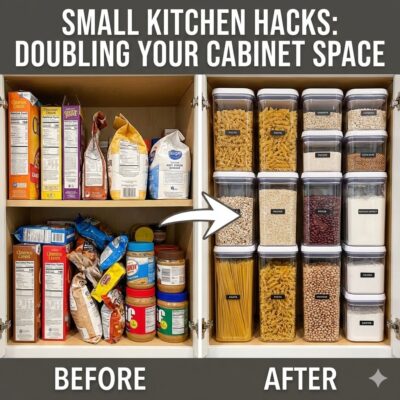
You probably have a shelf with cereal boxes lined up. Above those boxes, there is probably six inches of empty space before the next shelf starts.
That is dead space. And in a small kitchen, dead space is the enemy.
Standard food packaging—bags, oddly shaped boxes, round jars—is terrible at utilizing vertical space. You can’t stack a bag of rice on top of a bag of sugar. They just fall over. So, you lay them flat, taking up precious shelf real estate.
The Stackable Solution
To double your space, you need to change the geometry of your pantry. You need a uniform system designed to build up.
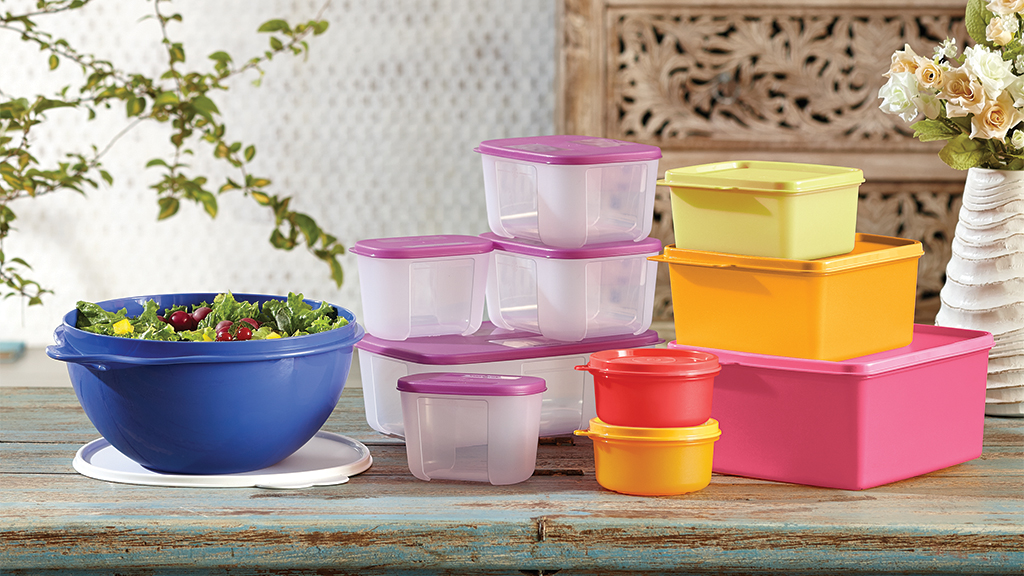
This is where investing in quality stackable storage (like Tupperware modular systems) changes everything. It’s not just about keeping food fresh; it’s an architectural hack for your kitchen.
Here is how to execute the transformation.
1. Square Pegs, Round Holes
The first rule of maximizing space: Ditch the round containers.
Round jars leave gaps between them. Square or rectangular containers fit snugly side-by-side, utilizing every inch of shelf width. When you are fighting for space, geometry matters.
2. The Importance of the “System”
You can’t just buy random square tubs and expect magic. You need a system.
Look for containers designed with uniform bases and recessed lids. This means the base of one container locks securely onto the lid of the one below it.
This creates a stable “tower” of food. You can stack three or four containers high—flour on bottom, sugar in middle, chocolate chips on top—without fear of them toppling over when you reach for something else.
Suddenly, that six inches of dead vertical space is holding five pounds of groceries.
3. Zoning Your Cabinets
Don’t just stack randomly. Create zones.
-
The Baking Stack: All your flours, sugars, and powders stacked in one vertical column.
-
The Pasta Stack: Spaghetti in a tall container, with shorter pasta shapes stacked beside it.
-
The Snack Stack: Crackers, pretzels, and nuts decanted into stackable containers. No more half-crushed cardboard boxes taking up space.
The Result: Kitchen Calm
When you switch to stackable storage, you don’t just gain space. You gain sanity.
You can see everything you own at a glance. No more buying duplicates because the first one was hidden behind a mega-box of cereal. You save money, you waste less food, and cooking becomes enjoyable again because you aren’t fighting your kitchen.
Stop letting dead space rule your small kitchen. Start stacking.