Have you ever been in the middle of cooking a big family dinner, and you reach for the salt… only to realize you just dumped a tablespoon of powdered sugar into your gravy?
We’ve all been there.
When your kitchen is in “chaos mode,” cooking feels like a chore. You spend half your time hunting for ingredients and the other half second-guessing what is inside those mystery containers in the back of the pantry.
At New Castle Party Sales, we believe that a truly efficient kitchen isn’t just about having the right tools. It’s about flow.
Today, we are talking about a simple, visual hack that professional chefs use to keep their kitchens running at lightning speed: The Color-Coding System.
The Psychology of Color
Our brains process color much faster than they process text.
If you have five identical clear containers on a shelf, your brain has to stop and read the labels (or look closely at the contents) to tell them apart. That takes a few seconds. Do that ten times while cooking, and you’ve lost a minute of focus.
But if you know that Red = Baking and Blue = Grains, your hand moves automatically. It’s called “Muscle Memory for the Eyes.”
Step 1: Assign Your Categories
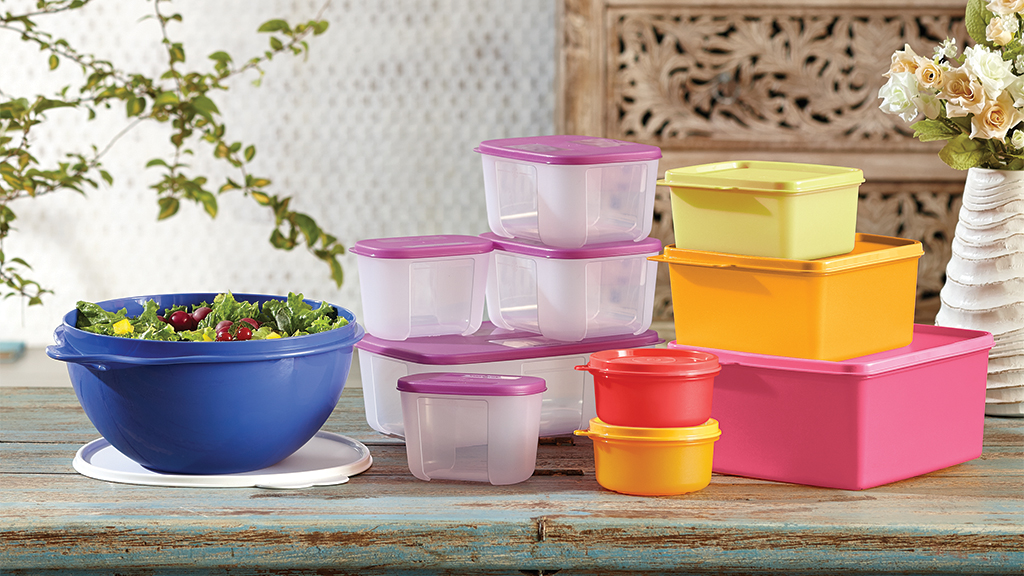
The secret to a color-coded kitchen is consistency. At newcastlepartysales.com, we offer various Tupperware lid colors specifically so you can build this system.
Here is a simple way to break it down:
-
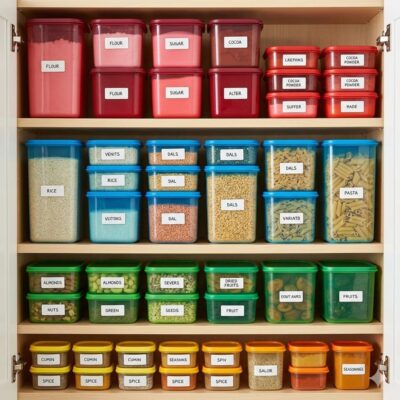
Red Lids: Baking Essentials (Flour, sugar, cocoa powder).
-
Blue/Black Lids: Dry Grains (Rice, dal, pasta, quinoa).
-
Green Lids: Healthy Snacks (Nuts, seeds, dried fruits).
-
Yellow/Orange Lids: Spices and Seasonings.
By sticking to this palette, anyone in the family—even the kids—knows exactly which “zone” to look in.
Step 2: The Art of the Label
Even with color-coding, a good label is the finishing touch.
Clear containers like the Tupperware Modular Mates are great because you can see the contents. But let’s be honest: Maida, Cornflour, and Powdered Sugar all look exactly the same through plastic!
Pro Tips for Labeling:
-
Uniformity: Use the same font or handwriting style for all labels. It reduces visual clutter.
-
Placement: Always place the label at the same height on every container.
-
The “Use By” Date: Don’t just label the name. Put a small sticker on the bottom with the expiration date from the original packaging.
Step 3: Streamlining the “Workflow”
Now that your containers are coded and labeled, organize them by frequency of use.
Keep your “Blue” (Grains) and “Red” (Baking) containers at eye level. They are the heavy lifters of your kitchen. The items you use once a month can go on the higher shelves.
When everything has a specific “color home,” cleaning up becomes faster, too. You don’t have to think about where that container goes. It just fits.
Why Tupperware Makes the Best System
You can find cheap containers anywhere, but they don’t offer the system that Tupperware does.
As an authorized distributor in India, New Castle Party Sales provides the genuine, airtight seals that keep your color-coded ingredients fresh for months. Our lids don’t warp, meaning your “Red Zone” will stay red and perfectly sealed for years to come.
A color-coded kitchen isn’t just about looking pretty for a photo. It’s about reclaiming your time. It’s about making cooking feel like a breeze instead of a battle.
Ready to start your color-coded journey? Head over to our shop and let’s pick out your first set of coordinated lids!